


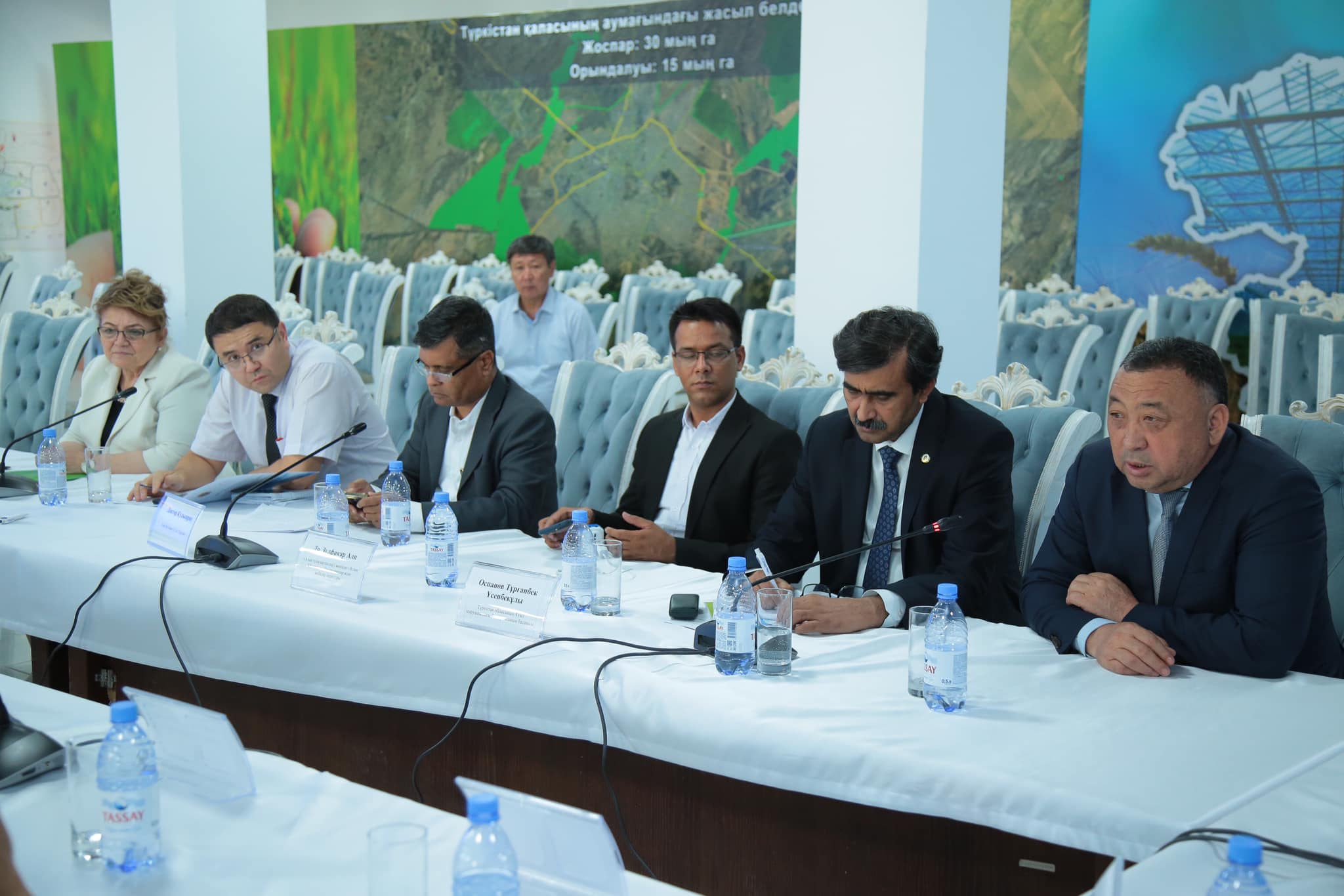
A meeting of regional akimat specialists, ecologists and international experts discussed the maintenance and expansion of the Turkistan region’s green zone. At the plenary session, specialists agreed that only trees adapted to the region’s soil and climate should be planted in Turkistan, and that new technologies should be introduced, a forest seed base formed and nurseries expanded.
The first speaker, Kairat Abdualiev, head of the Turkistan Regional Department of Natural Resources and Nature Management, noted that, pursuant to the President’s Address, a comprehensive plan has been adopted to plant 2 billion saplings across the country to improve the environment, and that the region is working to plant 170 million saplings on 110,200 hectares over 5 years.
According to the speaker, at the initiative of Akim Darkhan Satybaldy, the “Green Belt” around Turkistan is to be expanded to 30,000 hectares to improve the city’s environment; seedlings have already been planted and are being tended on 15,009 hectares.
“Because Turkistan and several districts of the region have a sharply continental climate, it is natural that 25 percent of newly planted forest trees fail to take root and dry out in the first or second year. Therefore, as provided by forestry rules, replanting to replace dead trees is a regular part of creating plantations. Accordingly, it was decided to extend the care period for green plantations to 5 years, noting that the survival rate of cultivated forest plantations does not exceed 55 percent. The Ministry amended the Rules for the autumn inventory of forest plantations and set the survival and preservation rate for cultivated forest plantations in Turkistan Region at 50 percent. Although Turkistan is included in the ecological zone, according to the autumn inventory the survival rate of green plantations around the city is currently 60–65%,” said K. Amangeldiuly.
Speakers also included Zhanar Temirbekova, Rector of the Khoja Akhmet Yassawi International Kazakh-Turkish University; Mukhabbat Turdieva, head of Bioversity International in Central Asia; Ali Zulfiqar, Director of Programmes and Projects of the Islamic Organization for Food Security; Temirzhan Aitbayev, Chairman of the Board of the Kazakh Research Institute of Horticulture and Vegetable Growing; Dr Kulkarni of Nath Bio-Genes (I) Ltd, India; Zh. Boranbay, head of the Department of Forest Resources and Forestry of the S. Seifullin Kazakh Agrotechnical Research University; Dr Oyture Anarbekov, head of the International Water Management Institute (IWMI) in Central Asia; and Gani Nazarbek, President of the national union “Baitak Bolashak”.
In addition, Andrey Kabanov, senior researcher at the A. Bukeikhanov Kazakh Research Institute of Forestry and Agroforestry, spoke about creating the Green Zone of Astana, and Laziza Gafurova, academician of the Mirzo Ulugbek National University of Uzbekistan, discussed the scientific basis for increasing the fertility of degraded irrigated arid soils. Beibit Duisenbekov, Chairman of the Board of the Kazakh Research Institute of Plant Protection and Quarantine, described methods of controlling forest pests. Professor Yakubjan Yuldashev of the Tashkent State Agrarian University presented “Uzbekistan’s achievements in forestry”, and Nurlan Balgabayev, Director for Research of the Kazakh Research Institute of Water Management, spoke on “Water scarcity problems and solutions”.
Participants noted that the work done around Turkistan to develop agriculture and introduce new technologies has required great effort, and that creating a green zone in such a climate is very difficult – summer temperatures exceed 40–45 degrees and rainfall is very low. Experts stressed that all necessary standards have been observed in the greening work, so this great effort will bear fruit.
The meeting highlighted the need to make full use of scientific achievements in the sector, with the A.N. Bukeikhan Kazakh Research Institute of Forestry and Agroforestry playing an important role.
Following the conference, which gave new impetus to improving the green zone, a resolution was adopted calling for stabilizing shifting sands and the wide use of drip irrigation in forest nurseries.
The resolution provides guidance for the work done so far and the work ahead.
Scientists from Uzbekistan, Kyrgyzstan, India, Pakistan and other Central Asian countries shared their experience and the subtleties of caring for trees in harsh climates. At the initiative of the regional akimat, a 7,700-hectare “Green Belt” around Turkistan was planned for 2019–2022; today seedlings have been planted and are being tended on a total of 15,009 hectares, and the Green Belt is to be expanded to 30,000 hectares.